
Black Soldier Fly Farming Explained: From Biology to Industrial Production
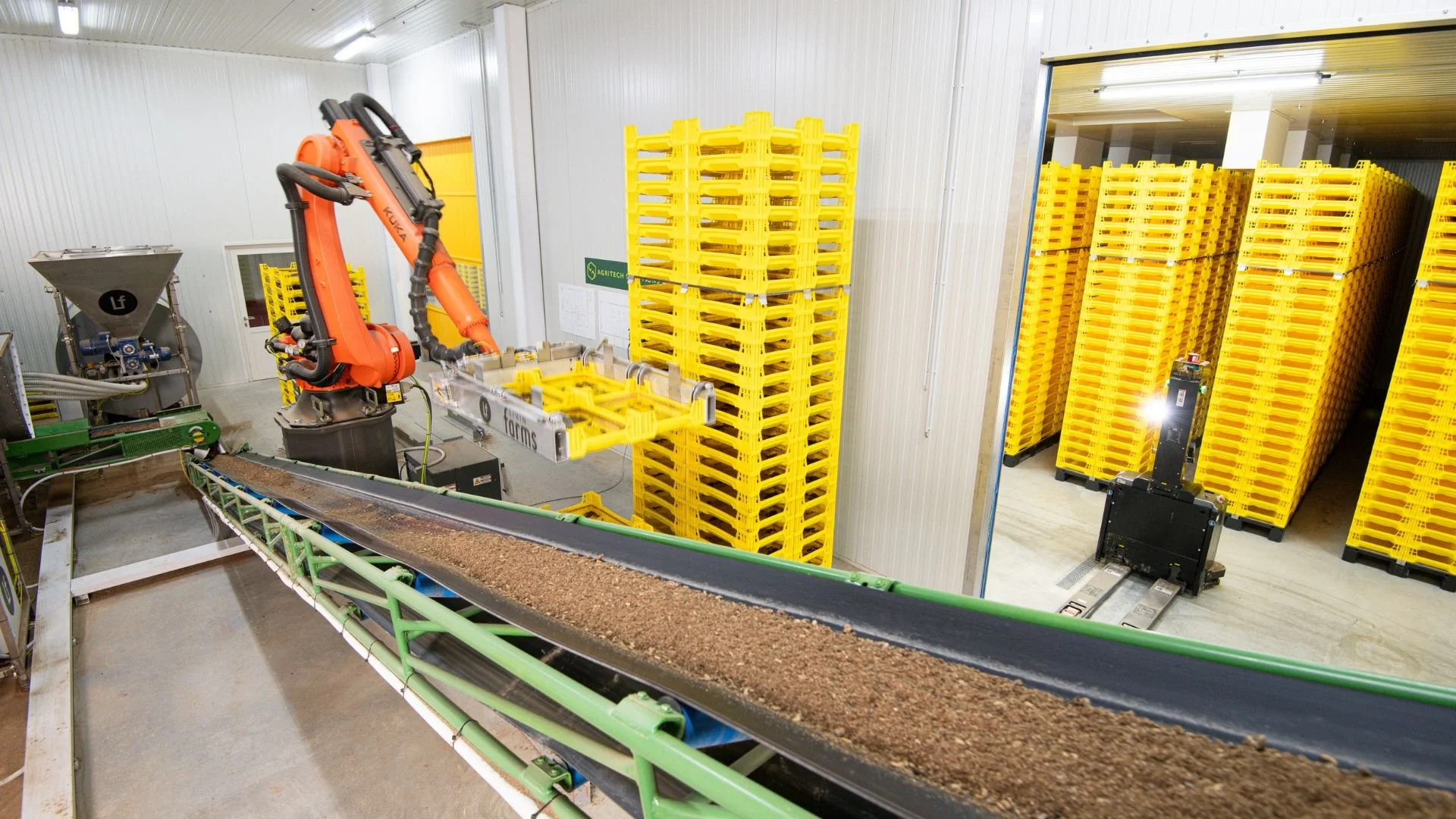
Industrial BSF larvae production LIVIN farms customer facility.
Black Soldier Fly (BSF) farming is one of the fastest-growing technologies in circular agriculture. By using Black Soldier Fly larvae (Hermetia illucens) to convert organic by-products into valuable products such as insect protein, insect oil and organic fertilizer, commercial producers can recover nutrients that would otherwise go to waste.
But successful Black Soldier Fly farming involves far more than simply raising insects.
Modern industrial BSF production combines biology, engineering, automation and process control to achieve consistent, large-scale production. From breeding colonies and environmental control to automated tray handling and feedstock optimisation, every step influences the performance of the system.
Whether you're exploring insect farming for the first time, planning a commercial BSF facility or looking to better understand industrial production, this guide explains how industrial production Black Soldier Fly farming works.
What is Black Soldier Fly farming?
Black Soldier Fly farming is the process of breeding and raising Hermetia illucens larvae to convert organic by-products into valuable resources.
During their larval stage, Black Soldier Fly larvae consume large amounts of organic material and rapidly convert it into biomass rich in protein and fat. After harvesting, the larvae can be processed into ingredients for animal feed, while the remaining frass can be used as an organic fertilizer.
Today, industrial Black Soldier Fly production serves two primary commercial applications: primary producers and agri-food businesses.
Primary producers, such as livestock farmers, integrate BSF production to rear fresh larvae for feeding poultry, pigs and aquaculture while recycling nutrients through the use of frass fertilizer.
Agri-food businesses, including food processors, breweries, grain processors and feed manufacturers, use BSF technology to valorize organic by-products into insect protein, insect oil and organic fertilizer while creating new revenue streams and reducing disposal costs.
Although every project is different, both groups share the same objective: transforming underutilized organic side streams into valuable agricultural products through efficient, scalable insect production.
Why is Black Soldier Fly farming growing so quickly?
The rapid growth of Black Soldier Fly farming is being driven by a combination of economic, environmental and regulatory factors.
Across agriculture and the food industry, millions of tonnes of organic by-products are generated every year. While these materials often retain significant nutritional value, they are frequently underutilized or costly to dispose of.
Black Soldier Fly larvae offer a way to recover that value.
By converting organic by-products into valuable agricultural products, BSF production enables companies to transform low-value side streams into new revenue opportunities while improving resource efficiency and supporting circular production systems.
Commercial Black Soldier Fly farming can generate several valuable products, depending on the production model:
Fresh larvae for feeding poultry, pigs and aquaculture
Insect protein for animal nutrition
Insect oil for feed and industrial applications
Frass fertilizer for agricultural use
Beyond creating valuable products, Black Soldier Fly farming helps businesses reduce reliance on conventional feed ingredients, improve the utilization of organic by-products and strengthen the resilience of local production systems.
As demand for sustainable feed ingredients, circular production and resource-efficient technologies continues to grow, Black Soldier Fly farming is becoming an increasingly attractive investment for both primary producers and the agri-food industry.
How does commercial Black Soldier Fly farming work?
Although every production facility is designed differently, successful Black Soldier Fly farming follows the same biological principles. Whether operating a small pilot facility or a fully automated industrial factory, every production system moves through five core stages: breeding, hatching, rearing, harvesting and processing.
1. Breeding
Everything begins with healthy breeding colonies.
Adult Black Soldier Flies are kept under carefully controlled environmental conditions where temperature, humidity and lighting stimulate mating and egg laying. Under optimal conditions, female Black Soldier Flies typically lay 500-900 eggs in a single clutch, making consistent breeding the foundation of every successful commercial production system.
Maintaining healthy breeding colonies ensures a reliable supply of eggs and ultimately determines the consistency of downstream production.
2. Hatching
Under optimal conditions, Black Soldier Fly eggs typically hatch after 3–4 days, producing tiny first-instar larvae.
In commercial production, consistency at this stage is essential. At LIVIN farms, these one-day-old larvae are supplied as Seedlings™, giving customers a reliable starting point for production without the need to operate breeding colonies themselves.
3. Rearing
Once the larvae begin feeding, they grow remarkably quickly. During the following 10–14 days, the larvae consume large quantities of organic material and rapidly convert it into valuable biomass rich in protein and fat.
They are placed onto carefully prepared substrates where environmental conditions are continuously monitored to support healthy development. Temperature, humidity, airflow and substrate quality all influence production performance.
One of the biggest misconceptions about Black Soldier Fly farming is that larvae can simply eat "anything organic". While BSF larvae can utilize a wide range of organic by-products, successful commercial production depends on carefully selected feedstocks with consistent nutritional composition, moisture content and physical characteristics.
4. Harvesting
When the larvae reach the desired harvest stage, they are separated from the remaining substrate.
Industrial production relies on automated harvesting and separation systems to improve efficiency, maintain product quality and reduce manual handling. Automation also improves traceability and helps ensure consistent production across every batch.
5. Processing
Depending on the production model, harvested larvae may be supplied fresh or processed into insect protein and insect oil. The remaining frass is collected separately and can be further processed into an organic fertilizer.
The combination of these products enables Black Soldier Fly farming to recover nutrients from organic by-products while generating multiple value streams from a single production process.
What makes industrial Black Soldier Fly farming different?
Producing Black Soldier Fly larvae on a small scale is relatively straightforward. Producing them consistently, every day, at industrial volumes is an entirely different challenge.
As production capacity increases, even small variations in feedstock quality, larval age, stocking density or environmental conditions can influence biological performance and affect an entire production cycle. Commercial facilities therefore rely on standardized production processes that minimize variability and ensure consistent results.
This is where engineering becomes just as important as biology.
Automation doesn't replace the biological process, it supports it. Automated tray handling, environmental control and production monitoring reduce manual handling, improve traceability and help maintain consistent conditions throughout the facility.
Rather than relying on individual operators, industrial Black Soldier Fly production depends on repeatable workflows that can be scaled efficiently while maintaining product quality and operational reliability.
As facilities continue to grow, the combination of biology, engineering and automation becomes the foundation of successful commercial production.
What do Black Soldier Fly larvae eat?
One of the key advantages of Black Soldier Fly larvae is their ability to convert a wide variety of organic by-products into valuable biomass. However, not every material is suitable for commercial production.
Depending on local regulations and the intended production model, Black Soldier Fly larvae can be reared on a range of feedstocks, including:
Fruit and vegetable by-products
Brewery spent grain
Grain processing side streams
Food processing by-products
Selected agricultural by-products
While larvae are remarkably adaptable, successful commercial production depends on far more than simply finding a material they can consume. Feedstocks must provide the right balance of nutrients, moisture and physical characteristics to support consistent larval growth, feed conversion and production performance.
For this reason, feedstock evaluation is often one of the first steps when planning a commercial Black Soldier Fly project. A comprehensive assessment helps determine whether available organic by-products are technically and economically suitable for insect production, reducing risk before investing in infrastructure.
Is Black Soldier Fly farming profitable?
Like any agricultural production system, the profitability of Black Soldier Fly farming depends on several technical, operational and market factors.
Key considerations include feedstock availability and cost, production capacity, automation, labour requirements, regulations and the market value of the final products. These factors influence both operating costs and long-term return on investment.
For this reason, successful commercial Black Soldier Fly projects rarely begin with equipment, they begin with planning.
Evaluating available feedstocks, defining production objectives and assessing technical and economic feasibility at an early stage helps reduce project risk, optimize facility design and support informed investment decisions.
For many commercial projects, a Bio Feasibility Study is the first step in determining whether Black Soldier Fly production is technically and economically viable for a specific business.
The future of Black Soldier Fly farming
Over the past decade, Black Soldier Fly farming has evolved from a niche concept into a rapidly growing industrial sector. As demand for circular production systems, alternative feed ingredients and resource-efficient technologies continues to increase, the industry is shifting from small-scale operations to standardized, industrial production.
The future of Black Soldier Fly farming is not simply about producing more insects. It is about building reliable production systems that integrate biology, engineering and automation to convert organic by-products into valuable agricultural products at commercial scale.
Future facilities are expected to become increasingly modular, automated and data-driven, allowing production to be scaled according to local feedstock availability and market demand. This approach enables Black Soldier Fly production to be integrated into existing agricultural and food processing value chains while improving operational efficiency and nutrient recovery.
For companies entering the industry, long-term success will depend on more than choosing the right insect. It will depend on designing a production system that can operate reliably, adapt to changing market requirements and remain economically viable for years to come.
Final thoughts
Black Soldier Fly farming has evolved into a sophisticated industrial production system that combines biology, engineering and automation to transform organic by-products into valuable agricultural products.
As the industry continues to grow, success will depend not only on understanding insect biology, but on designing production systems that are reliable, scalable and economically viable. For businesses considering commercial Black Soldier Fly production, careful planning, feedstock evaluation and the right technology are the foundations of long-term success.
Continue exploring Black Soldier Fly farming
If you'd like to learn more about industrial Black Soldier Fly production, explore these related resources: