
Industrial Insect Farming: Inside an Automated Black Soldier Fly Rearing Facility
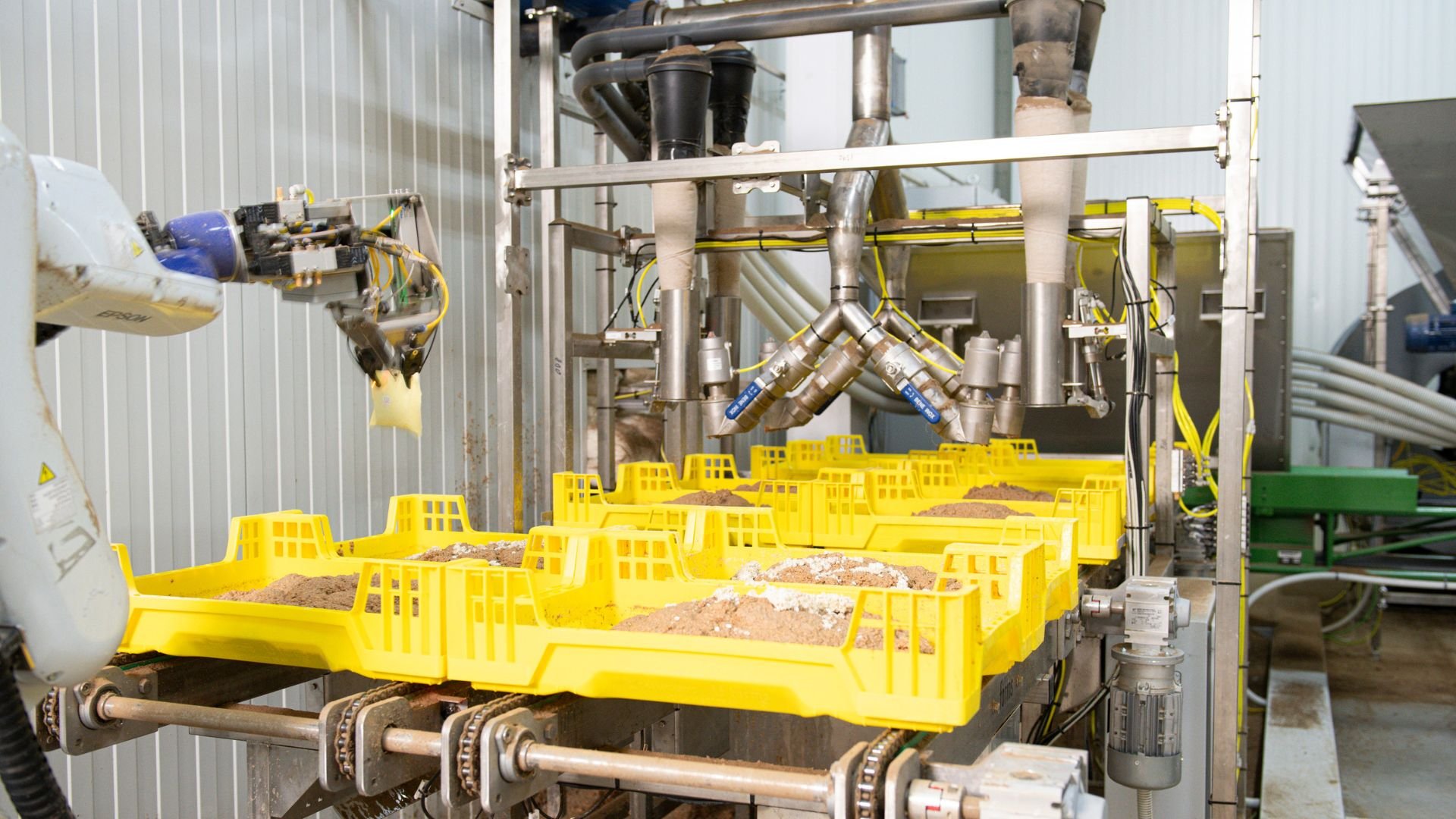
Insect farming factory in Germany, LIVIN farms customer facility.
How does industrial insect farming work in practice? And what does it take to produce around 1,000 tonnes of fresh Black Soldier Fly larvae per year?
In this factory tour, we take a closer look at an automated Black Soldier Fly (BSF) rearing facility in Germany. The facility combines robotic tray handling, automated feeding and dosing, AGV transport and controlled rearing conditions to produce fresh BSF larvae at industrial scale.
From the delivery of Seedlings™ (1-day-old BSF larvae) to the final separation of the larvae, every stage is integrated into a continuous production process designed for efficient and scalable industrial insect rearing.
Starting with Black Soldier Fly Seedlings™
The production process begins with Seedlings™.
LIVIN farms supplies the Seedlings™ directly to the production facility, providing a consistent starting point for the rearing process. This means customers do not need to manage the BSF breeding process themselves while benefiting from a reliable and controlled supply of young larvae.
The required feed is supplied as well, either Standard BSF Feed by LIVIN farms or a customised feed formulation developed based on a bio-feasibility study.
Automated Feeding and Dosing
The first stage takes place in the robot area of the insect farming facility.
Here, the feed is automatically mixed to create a homogeneous substrate. The prepared feed is then precisely dosed into the rearing trays.
This is handled by the automated Tray Handling System, which moves and positions the trays throughout the different stages of production.
Once the feed has been dosed, the Seedlings™ are added to the trays by an automated dosing system. One Seedlings™ pack is precisely dosed into each tray, creating consistent starting conditions for the larvae.
The trays are now ready for the first growth phase.
Pre-Rearing: The Growth Phase
After dosing, the trays are transported from the robot area to the pre-rearing area using automated guided vehicles (AGVs).
Here, the young BSF larvae grow for approximately 5 days under controlled conditions.
During pre-rearing, the larvae develop and increase in size before moving into the main rearing phase. The automated transport system moves the trays between the different production areas without requiring manual tray handling.
This combination of controlled conditions and automated logistics is an important part of an efficient industrial insect farming system.
Rearing: Growing BSF Larvae at Industrial Scale
After the 5-day pre-rearing phase, the trays return to the robot area.
At this stage, the larvae have developed further and move into the next feeding phase. The feed is changed to meet their increased nutritional requirements and is automatically dosed into the trays before they continue growing.
The trays are then transported back to the rearing area, where the larvae continue to grow.
The complete production cycle takes approximately 11 days from Seedlings™ to finished larvae. During this time, feeding, tray handling and internal transport are coordinated as part of the automated BSF farming system.
Automated Separation of BSF Larvae
Once the larvae have reached the required size, the trays return to the robot area for the final handling stage.
From there, the trays are transferred to the separation system. The BSF larvae are separated from the remaining material, completing the rearing process.
The separated larvae can then be directed to their intended application.
Fresh BSF Larvae for Animal Feed
Not every industrial insect farming facility produces insect protein powder or insect oil.
In this particular customer facility in Germany, the finished product is fresh, live BSF larvae, which are used directly as feed for piglets.
This is one of the applications of Black Soldier Fly farming: producing fresh larvae for direct use in animal feeding. Research has shown that pigs show a strong interest in live BSF larvae, which can provide both a nutritional feed source and edible environmental enrichment.
Depending on the facility and production setup, BSF larvae can also be further processed into products such as insect protein and insect oil, while the remaining material can be used as fertilizer.
From Seedlings™ to Industrial BSF Production
From one-day-old Seedlings™ to harvest-ready BSF larvae, the production cycle takes approximately 11 days.
The process demonstrates how industrial insect farming technology can combine biological production with automation: feed is prepared and dosed automatically, larvae are precisely distributed, trays are transported by AGVs, and larvae are separated at the end of the cycle.
For LIVIN farms, this is the basis of scalable industrial BSF farming, modular, automated systems designed to adapt to different production capacities, feedstocks and end products.